How Much Exercise Does a Puppy Need by Age?
Medically reviewed by Justin Shmalberg, DVM, CVA, ACVN, ACVSMR — For general education — not a substitute for veterinary care.
There is no single number that fits every puppy, but there is a workable rule of thumb, a real risk you're managing against, and a way to tell if you've overshot it.

On this page
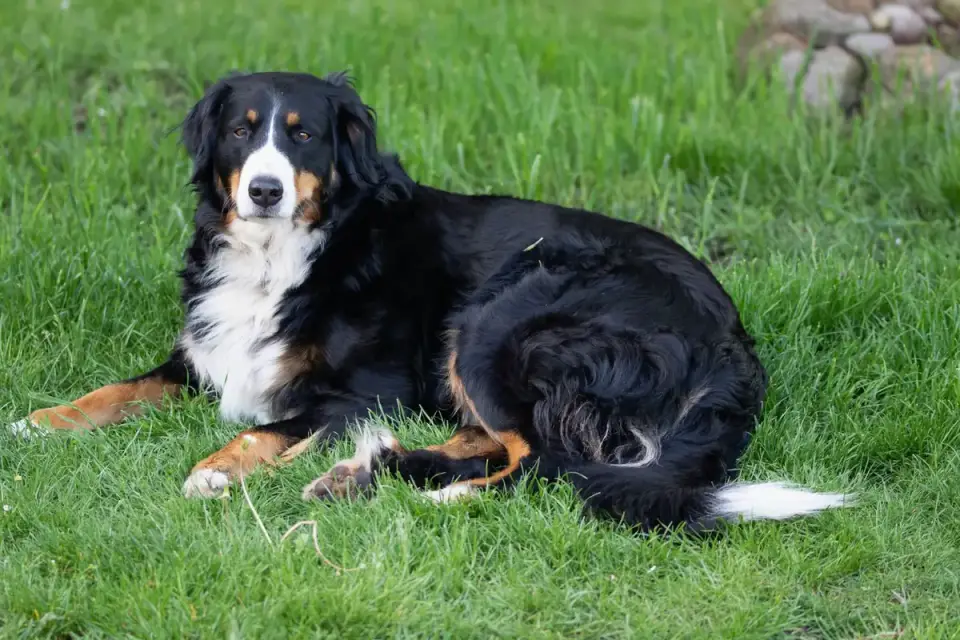
A client brought in a nine-week-old Bernese Mountain Dog puppy last spring, already 14 pounds and growing fast, because the family had been taking him on their usual 45-minute neighborhood loop. He wasn’t limping. He wasn’t in pain that anyone could see. But he was flat-out exhausted by the halfway mark, dragging on the leash, and the owners wanted to know if that was normal. It’s a scene I’ve watched play out with almost every large-breed puppy owner I counsel in that first year: the dog looks big enough to keep up, so the exercise plan gets built around the dog’s size instead of the dog’s age.
That distinction is the whole answer. A puppy’s exercise tolerance is set less by how large the breed will eventually be and more by how far along its skeleton is in a growth process that isn’t finished yet.
The rule of thumb, and why it’s a floor, not a formula
The guideline most owners have heard is some version of five minutes of structured exercise per month of age, up to twice a day — so a three-month-old puppy gets roughly 15 minutes, a five-month-old gets roughly 25. It’s a genuinely useful mental anchor, and I still hand it to owners who want a number to work from. It’s worth saying plainly, though: this isn’t a formula pulled from a controlled trial. No peer-reviewed study established “five minutes per month” as a validated threshold; it’s an extrapolated convention that’s become widespread because it’s memorable and roughly conservative, not because it was measured, a point Vet Voices makes plainly when tracing where the rule actually came from.
What the guideline does correctly is keep structured, repetitive exercise short while a puppy’s bones are still growing. What it doesn’t account for is breed, surface, and the difference between a walk and a sprint session — three variables that matter more than the clock.
Why the growth plate is the actual constraint
At the end of a puppy’s long bones sit growth plates — soft cartilage zones where new bone forms until the plate closes and hardens into solid bone. Until that happens, those plates are the weakest point in the skeleton, more vulnerable to compressive and shearing stress than the bone around them. Timing varies by size: growth plates in small breeds tend to close by around 9 months, medium breeds by 10 to 11 months, large breeds by 12 to 14 months, and giant breeds as late as 18 to 24 months. That’s the real reason a Great Dane puppy needs a more conservative plan for far longer than a Cavalier King Charles Spaniel — not because he’s clumsier, but because his skeleton stays under construction longer.
Repetitive high-impact loading on an open growth plate — hard sprints on pavement, forced roadwork, jumping in and out of a truck bed — is where the evidence gets more specific than the five-minute rule ever does. Research summarized by Walkerville Vet, following Newfoundland, Labrador Retriever, Leonberger, and Irish Wolfhound puppies in Norway, found that dogs under three months old who regularly used stairs had an increased risk of developing hip dysplasia, a condition the American College of Veterinary Surgeons describes as an abnormal formation of the hip socket that leads to joint laxity and, eventually, degenerative changes. The same body of research found something that surprises most owners: daily off-leash exercise on varied, park-like terrain was associated with a lower dysplasia risk, not a higher one. Restriction isn’t the goal. Repetition on hard, predictable surfaces is the problem.
What I actually tell owners to build a plan around
In my practice, I stopped leading with a stopwatch number years ago and started leading with three questions instead: what’s the surface, what’s the activity, and is the puppy choosing to stop. A puppy who wants to lie down mid-walk is giving you better information than any age-based formula. I ask owners to track it the way you’d track a toddler’s naps — loosely, by watching the dog, not by hitting a target.
For young, growing dogs specifically, that means favoring free play over forced pace: off-leash time in a yard or a low-traffic park where the puppy can set its own speed and stop when it wants to beats a fixed-distance leash walk on concrete, almost every time. It means skipping repetitive stair sets, structured roadwork, and jumping games — off a couch onto a hard floor, out of a car — until the growth-plate window has mostly closed for that breed size. And it means treating fetch and other sudden-stop, sudden-turn games with more caution in a growing large-breed puppy than in an adult, because that’s exactly the loading pattern the joint research keeps flagging. If you want a longer, age-by-age breakdown of walk length specifically, our age-by-age breakdown of walk length guide goes deeper than the general rule of thumb can here, and our walk-frequency guide covers how often to walk dogs of every life stage.
Feeding and joint-support supplementation come up constantly in these same conversations, so it’s worth being honest about what the science currently supports and where it stops. Glucosamine and chondroitin are among the most studied joint-support ingredients for dogs, and in vitro research on glucosamine HCl has shown it can help prevent experimentally induced cartilage degradation. Chondroitin, separately, has been studied for its role in supporting healthy synovial fluid homeostasis — the fluid environment a joint depends on to move without friction. That’s a meaningfully different claim than “prevents hip dysplasia,” and I’d resist any product that implies otherwise. For a growing puppy specifically, joint stress management is mostly a mechanical problem — surface, load, and repetition — with nutrition playing a supporting role, not a replacement for managing how the dog moves.
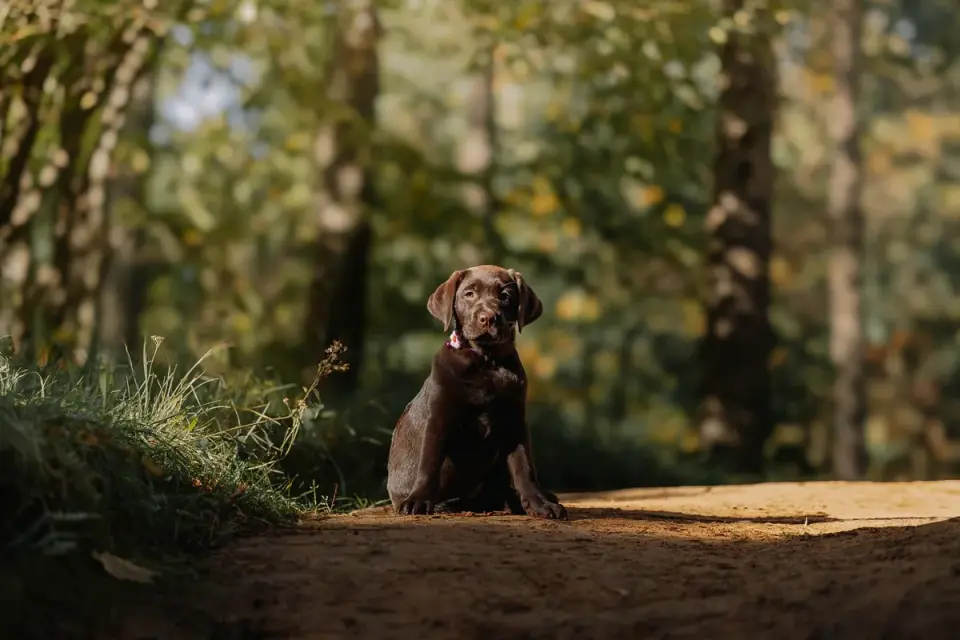
I think about a young Labrador I worked with a few years back, ten months old, 58 pounds, whose owners were training him for agility and had ramped up jump height faster than his frame was ready for. He wasn’t lame, but he was starting to hesitate before jumps he’d cleared easily a month earlier — the kind of subtle change that’s easy to miss unless you’re watching for it. We didn’t need imaging to make the call; we backed off jump height, cut roadwork to soft-surface only, and let his frame catch up over the following months before building intensity back in. That hesitation before a jump, more than any calendar date, is the signal I trust.
The bottom line
Use the five-minutes-per-month rule as a floor for structured walks, not a ceiling on all activity, and weight your decisions more heavily toward surface and repetition than toward the stopwatch. A large or giant breed puppy needs that conservative approach for longer than a small breed does, simply because its growth plates stay open longer — that’s biology, not a guess. If you’re building a longer-term mobility plan for a dog recovering from an injury or managing an existing joint condition, at-home physical therapy resources and a rehab vet’s input matter more than any general puppy guideline. For most healthy, growing puppies, though, the plan is simpler than it looks: let the dog set the pace, keep the surfaces forgiving, and be more careful about stairs and hard sprints than about minutes on the clock.
Frequently asked questions
Is the "5 minutes per month of age" rule scientifically proven?
No. It's a widely used, conservative rule of thumb, not a figure drawn from a controlled study. It's a reasonable starting anchor for structured walks, but surface, activity type, and how the puppy is actually responding matter more than hitting an exact number.
When do a puppy's growth plates close?
It varies by size: roughly 9 months in small breeds, 10 to 11 months in medium breeds, 12 to 14 months in large breeds, and as late as 18 to 24 months in giant breeds. Growing bone stays more vulnerable to stress-related joint problems until that closure happens.
Is stair climbing actually risky for puppies?
Research following Newfoundland, Labrador, Leonberger, and Irish Wolfhound puppies found that regular stair use before three months of age was linked to a higher risk of hip dysplasia, while daily off-leash exercise on varied terrain was linked to lower risk.
Should I stop all off-leash play until my puppy's growth plates close?
No. The same research associated free, off-leash movement on varied terrain with lower dysplasia risk. The activities to limit are repetitive, high-impact ones on hard surfaces, like stair sets and structured roadwork, not general play.
Sources
- Puppy Exercise: 5 Minutes Per Month of Life? — Vet Voices
- Canine Hip Dysplasia — American College of Veterinary Surgeons
- When It's Safe To Run A Puppy: The Evidence — Walkerville Vet