Is an Underwater Treadmill Worth It for My Dog?
Medically reviewed by Justin Shmalberg, DVM, CVA, ACVN, ACVSMR — For general education — not a substitute for veterinary care.
An underwater treadmill can genuinely change a dog's mobility, but whether it's worth paying for depends on the diagnosis, not the hype.

On this page
The dog I remember best in a water tank was a nine-year-old Lab mix named Cooper, six weeks out from a TPLO on his right knee. His owner had watched him go from clearing the back porch steps in a single bound to hesitating at the bottom of them, weight shifted onto the good leg, ears back. She’d read that an underwater treadmill might get him moving again faster than leash walks alone, and she wanted to know if it was worth the drive across town twice a week and the per-session bill. That’s the question almost every owner asks me the same way: not “does hydrotherapy work,” but “does it work enough, for this dog, to be worth what it costs.”
Here’s where I land: an underwater treadmill is worth it when a dog has a specific, diagnosed reason to need controlled, low-impact loading — post-surgical recovery, arthritis flare management, a neurologic gait deficit — and when a trained professional is running the sessions as part of a defined program. It is not worth it as a general wellness activity you book because a dog seems stiff, and it is not a substitute for a veterinary diagnosis. The water is a tool, not a cure, and the value depends almost entirely on who is holding it.
Check these five things before you book a session
- A diagnosis drives the plan. The clinic should be working from a specific condition (post-op, arthritis, neuro deficit), not a generic “mobility boost.”
- A certified professional runs it. Look for a rehab veterinarian or a certified canine rehab practitioner (CCRP/CCRT), not just tank access.
- Water depth and speed are set to the dog, not the tank’s default. Depth changes how much weight the joints bear.
- There’s a session count and a re-check point. An open-ended “come whenever” plan is a red flag; a real program has a number attached and a plan to reassess.
- You’ve asked what it can’t do. No underwater treadmill spot-treats a single sore muscle or replaces imaging and diagnosis.
- The cost is compared against a timeline, not a flat yes/no. A handful of sessions during a recovery window reads differently than an indefinite weekly habit.
What each of those actually means
A diagnosis matters more than most owners expect. Underwater treadmill work is prescribed for arthritis, post-surgical recovery, neurologic problems, cruciate injuries, and weight management in dogs carrying enough extra mass to stress their joints on land, according to the American Kennel Club. Each of those has a different reason for being in water — a torn ligament needs controlled loading during healing, while an arthritic hip needs range of motion without the jarring of a hard surface. A clinic that can’t tell you which one your dog fits into is guessing.
Who runs the session is the next filter, and it’s the one owners skip most often. A tank with warm water and a treadmill belt is equipment; a program is a person who knows how to read a dog’s gait, adjust water level mid-session, and stop before fatigue turns into a bad habit. The American Kennel Club notes that hydrotherapy is one treatment modality among several and works best as part of a broader rehabilitation plan rather than a stand-alone fix, which is exactly why the person running it matters as much as the water itself.
Depth is not a minor detail — it’s the mechanism. Water level changes how much of the dog’s body weight the limbs are actually bearing during each stride, which is the entire point of the exercise. Set too shallow, the dog is basically walking on land with wet fur. Set too deep, buoyancy removes so much load that the joints get almost no working range against resistance. A program adjusts depth deliberately for the joint and condition being treated, not by habit.
What the research actually measured
I don’t take “hydrotherapy helps” claims at face value any more than I’d take a supplement label at face value, so it’s worth looking at what’s actually been measured rather than what’s implied. A pilot study following 50 dogs through a 10-session underwater treadmill program — twenty-minute sessions, twice weekly, over five weeks — measured passive range of motion in the carpal, elbow, shoulder, tarsal, stifle, and hip joints with a goniometer before and after the program. According to the PMC record of that study, flexion and extension improved significantly across all six joints measured, and the improvement wasn’t tied to the dog’s age, which suggests the therapy’s benefit holds across a broad range of patients rather than being limited to younger, more resilient joints. That’s a genuinely useful data point: it tells you the mechanism (repeated, resisted, low-impact movement in water) produces a measurable joint-mobility change, on a defined protocol, over a defined timeline.
What it does not tell you is that ten sessions fixes arthritis, or that any tank at any depth run by anyone will replicate those numbers. The study protocol was specific — set depth, set frequency, set duration — and that specificity is the part owners tend to skip when they’re just asking whether “hydrotherapy” in general is worth trying.
One recovery, five weeks, and what actually changed
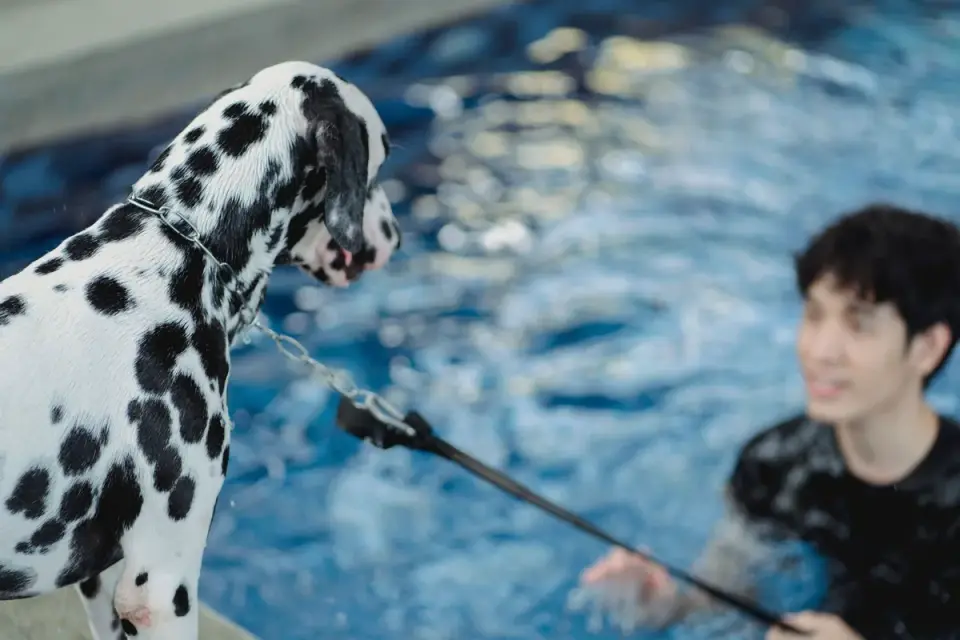
Cooper’s program ran twice a week for five weeks, water set at about elbow height to start and dropped gradually as his strength came back. Nothing about it looked dramatic from the observation window — he walked in place against a mild current while a tech watched his gait and adjusted the belt speed. What changed was slower and more specific than his owner expected. Week two, he was still favoring the leg getting out of the tank. Week four, he took the clinic’s three entry steps without pausing. By week six, back at home, he cleared the porch steps again, though his owner noted he still sat down to rest after longer walks in a way he hadn’t before surgery. I don’t present that as a study result — it’s one dog, one program, one surgeon’s post-op protocol running alongside the water work, not a controlled comparison. But it’s the shape most successful cases take: gradual, session-by-session, tied to a specific injury and a specific plan, not a sudden transformation from a few tank visits.
Where it falls short
An underwater treadmill can’t diagnose anything, and it can’t target one inflamed structure the way a targeted therapy or medication can. It also isn’t a great fit for dogs that find the water itself stressful — a session that spikes a dog’s heart rate and blood pressure from anxiety works against the goal, not toward it, and a good facility will stop and reassess rather than push through it. And it’s genuinely not necessary for every dog with mild stiffness. A dog treadmill compared with outdoor walking or a structured at-home physical therapy program can accomplish a lot for a dog whose issue is general deconditioning rather than a specific joint or post-surgical problem, at a fraction of the cost and without the drive to a clinic.
Cost is where the “worth it” question usually gets decided in practice. Sessions vary by clinic and region, and most programs run multiple visits across several weeks rather than a single appointment, so the number that matters is the total cost of the program relative to the recovery window, not the per-visit price in isolation. For a dog on a defined post-op or arthritis-management plan, that math tends to work in the treadmill’s favor. For a dog whose owner is hoping a few sessions will substitute for weight management, a proper walking routine, or joint-focused strength work like balance and proprioception exercises, it usually doesn’t.

Where I land, and the counterargument I take seriously
The strongest pushback I hear is that hydrotherapy is expensive and inconvenient compared with just walking a dog more consistently on land, and for a lot of dogs, that’s a fair point — a well-structured land routine covers real ground. But it doesn’t cover the specific case an underwater treadmill is built for: a dog whose joints need loaded movement without full body-weight impact, during a window when land walking would either hurt too much or undo the surgery. That’s a narrow use case, not a general one, and I think owners do their dogs a disservice when they treat “underwater treadmill” as a catch-all mobility fix rather than a targeted tool for a specific problem.
So the honest answer to “is it worth it” isn’t yes or no — it’s whether your dog’s mobility problem is the kind of problem the water is built to solve. If a vet has identified a post-surgical, arthritic, or neurologic reason for controlled aquatic loading, and the facility running it is certified and working from an actual plan, it’s very likely worth the cost and the drive. If the goal is just “get my stiff dog moving more,” a walking routine sized to the dog’s age and condition usually gets there for less money and less hassle.
Frequently asked questions
How many underwater treadmill sessions does a dog usually need?
Programs are typically built around a defined block, such as roughly ten sessions over several weeks, with a re-check to see whether the goal — range of motion, strength, post-surgical progress — has been met before continuing.
Can I do underwater treadmill therapy at home?
No. It should be run by a veterinarian or certified canine rehab professional who can adjust water depth and pace and watch for signs of stress or overexertion in real time.
Is an underwater treadmill better than regular walking for an arthritic dog?
It serves a different purpose. It offers loaded movement with less joint impact than land walking, which helps during flare-ups or recovery, but a structured walking routine still matters for everyday conditioning once a dog is stable.