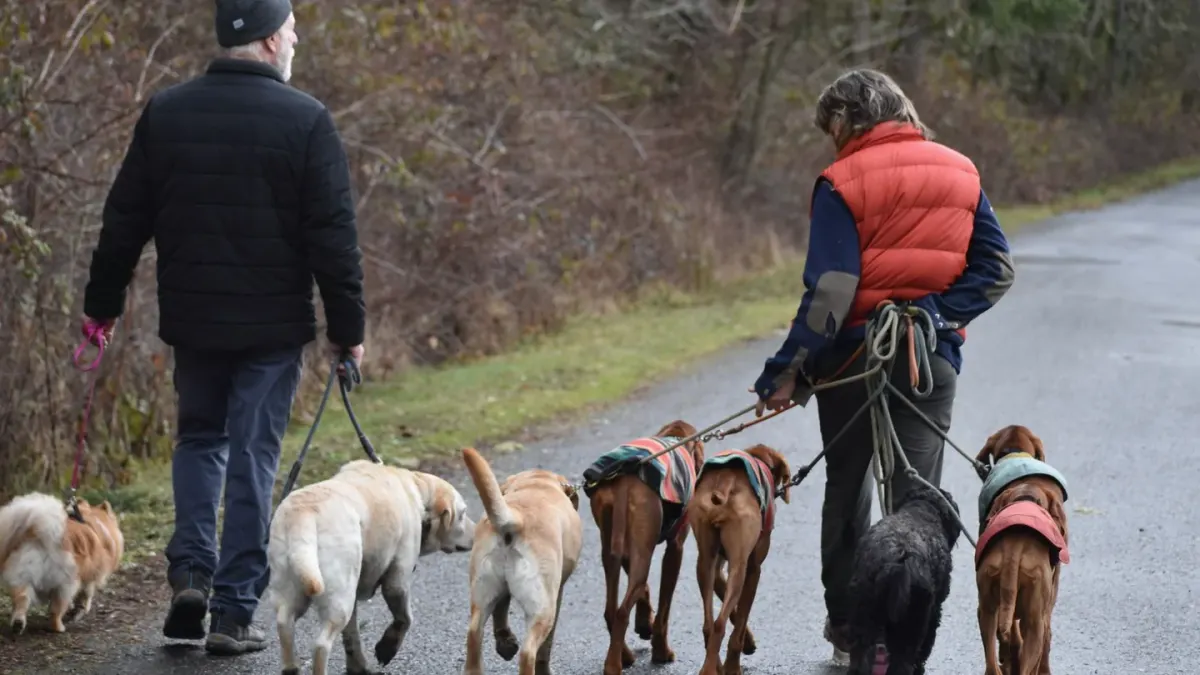
Brittany noticed Gidget hesitating for two seconds before pushing up from the tile, and that pause changed how the 7-year-old Doberman’s walks got planned in West Palm Beach heat.
My verdict is direct: if you choose or raise a large breed, build the joint plan around lean body weight and controlled impact first, with nutrition, conditioning, and veterinary screening next, and supplements only as adjunctive support. The mechanics demand it. Cartilage, cruciate ligaments, and developing growth plates all fail faster when every step carries extra pounds across a long lever arm.
Large size multiplies force. Ground reaction force travels through paw, carpus, elbow, shoulder, or through stifle and hip, and articular cartilage distributes that load across a thin fluid film. When body mass rises faster than muscle and joint congruity can support, contact stress concentrates on smaller areas of cartilage and subchondral bone. That concentration explains why developmental disorders cluster in big, fast-growing dogs.

Which large breeds carry the most predictable load problem
Risk is not evenly spread. Hip dysplasia, elbow dysplasia, osteochondrosis, and cranial cruciate ligament disease concentrate in breeds with heavy frames, rapid growth, or straight rear angulation. Labrador Retrievers, German Shepherds, Golden Retrievers, Rottweilers, Bernese Mountain Dogs, Newfoundlands, Saint Bernards, Great Danes, Mastiffs, and Doberman Pinschers appear repeatedly in screening data.
The Orthopedic Foundation for Animals tracks hip conformation across breeds and reports markedly higher dysplasia frequency in several giant and large breeds than in small breeds, which matches the mechanical prediction that looser, heavily loaded hips remodel poorly. Elbow dysplasia follows a similar pattern in Labradors, Rottweilers, Bernese Mountain Dogs, and German Shepherds, where fragmented coronoid process and ununited anconeal process disrupt a tightly congruent joint.
What growth rate has to do with it
Endochondral ossification converts growth-plate cartilage into bone on a strict timetable. Excess calories, excess calcium, or a steep growth curve can disturb that conversion, leaving thickened cartilage that cracks or separates as osteochondritis dissecans. Controlled growth does not guarantee normal joints, yet rapid weight gain during the 3-to-8-month window remains the most modifiable lever an owner controls. For giant-breed growth questions, see Are Joint Chews Safe for Giant-Breed Puppies?
Lean is protective.
That single-sentence paragraph carries the weight data behind it: lifetime restricted-feeding studies in Labradors showed delayed onset and lower severity of osteoarthritis compared with fully fed siblings. Fat tissue also shifts from passive load to active signaling, releasing adipokines that sustain low-grade inflammation around already stressed synovium.
Why weight control beats every powder in the scoop
Glucosamine and chondroitin are among the most studied joint support ingredients for dogs. Green-Lipped Mussel contains omega-3 fatty acids and glycosaminoglycans that have been studied for joint support. Those ingredients may support cartilage matrix and normal inflammatory responses, but they do not change contact mechanics, tighten a lax hip, or stabilize a partial cruciate tear.
The Merck Veterinary Manual describes osteoarthritis in small animals as a progressive loss of cartilage with secondary bone remodeling, often following developmental disease, ligament injury, or chronic overload. Once osteophytes form and joint congruity shifts, no oral ingredient reverses the shape change. Weight reduction lowers peak force every stride, which preserves the remaining cartilage better than any adjunctive capsule can.
Vets often see the same inflection in large adults around age six to eight: slower rises, shorter play bouts, stiffness after rest that warms out of the walk. Felicia described that pattern in Braxton, her 8-year-old Portuguese Water Dog mix in Thornton, when a half-mile loop started requiring a ten-minute rest before stairs. The useful response is measurement, not assumption: body condition score, muscle symmetry over quadriceps and gluteals, timed rise from down, and distance before lagging.
Dose math matters here as dogs age and weights drift. A chew formulated for a 50-pound dog underdoses a 95-pound Rottweiler unless servings scale, which is why label review helps: Adjusting a Dog’s Joint Supplement Dose as Their Weight Changes and How to Adjust Joint Supplement Dosage for a Senior Dog
How I would raise and exercise a large breed for joints
Keep growth steady, not maximal. Feed a large-breed growth formula with controlled calcium and total calories to a lean body condition score of 4–5 out of 9, with ribs palpable under light cover. Rapid puppy bulk looks impressive and loads cartilage that has not finished ossifying.
Trade repetitive impact for traction and strength. Short, frequent walks on grippy surfaces, hill work at a walk, cavaletti poles, and swimming with a controlled exit build periarticular muscle without pounding open growth plates. I would limit forced running, extended fetch with hard stops, and repetitive stair or jump work until growth plates close, often 12–18 months in giant breeds.
Screen the structure you cannot see. Hip and elbow radiographs under standardized positioning, patellar and cruciate examinations, and gait assessment give a mechanical baseline before limping starts. Bulldogs and other heavy-front breeds illustrate why timing matters, a point explained further in At What Age Should a Bulldog Start Joint Support?
What would change my position? Randomized, long-term data showing a supplement or single ingredient prevents dysplasia, cruciate rupture, or osteochondrosis in large breeds independent of weight and loading. Current evidence does not show that. The strongest joint signal remains load management, which fits the anatomy I was trained to repair: soft-tissue stabilization fails when tension is wrong, orthopedic repair fails when alignment and load are wrong, and surgical management succeeds when mechanics are restored first.
So where does that leave owners comparing large dog breeds? Choose the frame you can keep lean, plan floors, ramps, and exercise around impact, and treat any joint chew as adjunctive support inside that plan rather than the plan itself.
Frequently asked questions
Are large dogs guaranteed to get arthritis?
No. Risk is higher because load, growth rate, and inherited conformation stack against large joints, but lean weight, controlled exercise, and screening lower severity and delay onset.
Should a large-breed puppy get joint supplements to prevent hip dysplasia?
Supplements do not reshape a shallow socket. Prioritize lean growth, appropriate large-breed nutrition, low-impact conditioning, and veterinary screening, with any supplement as adjunctive support only.
Sources
- Hip Dysplasia — Orthopedic Foundation for Animals